 Extremely minimal set of photographs from Stockholm, Sweden. If it
weren't for Vasa, I suppose there photos could be from anywhere. You
have been warned. See the few photos
here.
]]>
Extremely minimal set of photographs from Stockholm, Sweden. If it
weren't for Vasa, I suppose there photos could be from anywhere. You
have been warned. See the few photos
here.
]]>
In 19 July 2017 I received an unexpected phone call. By means unknown to me, my phone displayed not only the number (+442079460873) but also word "London". Because of reasons, I typically answer these calls. I did answer the call.
I was greeted by a woman who spoke reasonably good English, but her pronunciation wasn't exactly the best I've heard. I could not identify the dialect, but my suspicions pointed towards east. The caller first wanted to confirm she was speaking with a person with my name, yes? "That would be me." The call centre noise in the background was rather annoying. She then continued to introduce herself as a researcher at CTAM in London. It took a couple of pardon-mes and sorries to actually make the abbreviation out. The company was supposedly doing an economy research on European households. "Could you answer some questions, please?"
I can't remember the details on how the call then proceeded, but the questions where mostly meaningless, and the data should've been readily available in most EU countries. "Do you own an apartment, yes or no?" "Do you have a mortgage, yes or no?" Some of the questions were utterly irrelevant. "Is this your personal phone, yes or no?". As is typical for me, I answered nearly all questions with proper sentences such as "I do" or "I have", or "it is". Repeating the yes-or-no part started to sound a little fishy at some point. I am certain I slipped some direct "yesses" a few times.
Not all the questions were like that, though. She was also interested in my income bracket, my profession, and my thoughts on how the recent efects in Europe have affected my financial security. For whatever reason, she wasn't happy with "software engineer", so she had to settle with "a programmer". Obviously she'd also like to have my email. I provided her with a GMail address that I only use for irrelevant stuff.
After seven minutes of her time and my holiday being closer to its end, she thanked and ended the call. I did a quick internet search with the phone number and ended up reading an article by national news agency about strange international phone calls. The recommended action was obviously not to answer the calls. The article did not speculate what the attack vector for the calls was. Reading about the fishing for yesses, I grew a little nervous. The few yes answers I'd given worried me, but eventually managed to put the thought aside. Should it become necessary, I'd have a recording of the call. Except I didn't. The latest software update to my phone meant the recording application was no longer functioning. Oh dear.
On 27th my phone beeped again. A call from a secret number. I left my workstation and went to one of our meeting rooms, and answered the call. By now
...
]]>Get the sources. You may also read an earlier entry and/or see the earlier version(s).
]]>
Extremely minimal set of photographs from Stockholm, Sweden. If it
weren't for Vasa, I suppose there photos could be from anywhere. You
have been warned. See the few photos
here.
]]>
Long story short: I've rewritten iodine-client-start to have minimal dependencies and to run with standard Bourne shell. The only additional packages this script should require are iodine and iproute.
Back in the days when Nokia N810 was my main and only "internet tablet", I discovered iodine, a IP-over-DNS tunneling... thing. I set up my own server and tried to set up the client with provided iodine-client-start script. Things didn't work out-of-the-box and I soon discovered number of dependencies. Because I was keen to see iodine in action, I quickly built a package with all necessary dependencies in it. If my memory serves me right, I had to strip down things like ipcalc to run on Diablo, and compile some others. Eventually I got Iodine to work, and never bothered to properly package things.
When I finally got a N900 of my own, I tried to set up Iodine client for it as well but failed. Life being busy and all, I never get around to get things working. Until two weeks ago. I was walking back home from downtown and being nice and sunny day, I stopped to sit on a bench. I can't remember what I was going to check online, but in any case I tried to establish an internet connection using an open AP that happened to be there. It turned out it was one of those that requires a login. One thing lead to another, and by the time my head hit the pillow that night, I had a nice little script ready for field testing. Much to my surprise it worked without a hitch - except that the routing to my own subnet was broken from my iodined.
]]>Some months ago I switched to i3 window manager after discovering a Vim option to highlight column 81. As silly as it may sound, not easily spotting long lines was one of the biggest reason for not switching earlier. However, colorcolumn option wasn't perfect. It messed up using X11 to paste text from Vim.
When I first grew tired to colorcolumn and loads and loads of unwanted whitespaces in pasted text, I figured I'd use X resources to configure rxvt to draw column markers. These markers would obviously be completely separate from actual text buffer. After struggling to introduce X resources in rxvt, I realised my plan also was flawed; this wouldn't work properly with Vim's windows.
When the time to have a Christmas party at work arrived, I realised I'd have quality time to work on this again. I patched rxvt with a private set of VT escape sequences to manage a list of column markers. Adding this functionality was surprisingly simple and the unminimised patch (without partially implemented X resources) was just 145 lines. The next step would be to create a Vim script, or in worst case scenario, patch Vim to send required sequences to set the markers.
When I was testing my fancy little patch, I came across some settings in Vim configuration file I had added for highlighting redundant whitespaces a decade earlier. That's when I realised I could use exactly same thing for highlighting long lines. It wouldn't be exactly as pretty as my fancy little patch, but there would be no patching and no compiling.
The next time I think I need to patch some piece of software, I really need to sit on my hands and think if it's really the only way. That would have a lot of time.
]]>Earlier today I was trying to copy the stuff from an micro SD card, but failed miserably as the kernel log didn't mention a thing about the card when it was inserted. Puzzeled, I inserted the card in my cheap Chinese Android tablet and behold, the stuff was there. I then tried the same card with a Linux laptop with no success. Baffled, I also tried other SD cards (regular and micro) with my desktop. None of the cards worked. The card reader appeared as /dev/sdg and that's all there was for it. At the same time using an USB adapter for the micro SD card worked perfectly fine.
After asking the almighty Google about this, someone suggested running lshal as a mean to investigate remotely similar problem. After installing HAL, running it and grepping the output I saw the card was now available through /dev/sdg1. dmesg now also mentioned this "newly" attached device.
Obviouly I've fallen behind after introduction of DEVFS and udev, as I didn't even think of HAL. In fact, I don't even really know what HAL is. I've known what it stands for, I've known that for quite some time, but that's about it. I still find it odd that dmesg didn't list the device until hald was started (upon running lshal). Also, if HAL was so crucial part of the system nowadays, why is it marked as optional in Debian? My understanding here is rather limited, but why did things work so differently for "plain" USB sticks?
Oh well, immediate problem solved. Perhaps I educate myself about all this later.
]]>When I first started using GNU/Linux back in 2000, one of the first choices I made was picking a window manager. I tried an early version Sawmill (Sawfish), Enlightenment, Fvwm and others. Eventually I settled with Fvwm which could be configured to be near-perfect match for me. Even though I had come from Amiga and Workbench, I absolutely loved focus-follows-mouse, virtual desktops and the pager, the ability to bring windows to front and sending them background by simply clicking the frame and so on. As time went by, I added more obscure commands to move and resize windows and removed all but one widget from the window frame.
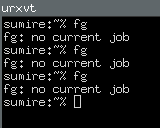 Even though I was mostly happy with Fvwm and Fvwm2, I often ended up opening
far too many terminals for tasks that were only supposed to take seconds. My
usual workflow to use several desktops and organise stuff accordinly usually
worked well because I only had one or two overlapping windows on each desktop.
With one-shot windows, however, I sometimes had to hunt for that one terminal
with Vim put in the background. Furthermore, this helped me to form a habit of
typing "fg" whenever there was no Vim running on that terminal.
Clearly there was something wrong.
Even though I was mostly happy with Fvwm and Fvwm2, I often ended up opening
far too many terminals for tasks that were only supposed to take seconds. My
usual workflow to use several desktops and organise stuff accordinly usually
worked well because I only had one or two overlapping windows on each desktop.
With one-shot windows, however, I sometimes had to hunt for that one terminal
with Vim put in the background. Furthermore, this helped me to form a habit of
typing "fg" whenever there was no Vim running on that terminal.
Clearly there was something wrong.
Eventually I was introduced to tiling window managers. I loved the idea and tried a few, namely xmonad and wmii. I decided to skip awesome for naming reasons and ion because of the author's attitude. These experiments confirmed that I liked the concept, but could not switch because I was so fixed with having a terminal window limited to exactly 80 columns. This was because I believed (and still do) that no line of code should have to be wider than 80 columns or there was something wrong with it. Yes, even with 8-column indentation. If there wasn't an option to force certain windows to certain size, this would be a showstopper.
As time passed, I came across a Vim option (colorcolumn) to highlight given column. Even though the option made pasting stuff over X a bit more cumbersome (as each line would have whitespaces at the end of each line), I started using this option. Some time later I heard about i3 and decided to give it a go on my home computer. Configuring i3 took almost no time and with this newly discovered Vim option, I was happy. When I realised that I could make certain window classes to always be floating I was even happier. These always floating windows would only be used to very temporary stuff such as showing feedback for keyboard shortcuts that controlled command line applications.
After a few months of running i3 on my home computer, I
...
]]>Stellan Andersson (Dane) is my new hero. Seems that every time I go through new stuff on HVSC, I find something new from Dane that I love. Similarly, much of the time when I listen to my favourite SIDs, these gems by Dane really get my attention. Enjoy.
]]>Back in November when I had finally received my first Android device ever I also tried to purchase a protective cover for it. I turned my attention to PandaWill that was selling a neat looking case that didn't add too much bulk to my otherwise compact device. I placed an order on 3 October and started waiting. I liked their check out process for not forcing me to create an account. The final step in the process confirmed my order and said that I'd receive another confirmation in an email with full details including order and invoice numbers. I never did.
Three weeks passed and hadn't heard anything from PandaWill. Not even that confirmation email. I didn't think much of it as I didn't register and I figured I had to be minority and the system was largely untested for this use case. Still, being tiny bit worried, I opened their fancy online support, explained the situation and was given my invoice number that I should be able to use to track the status of my order on their website. I couldn't. Using the feature would have required me to create an account. Them having confirmed that my order had been received I was content for time begin. Their online support was friendly and didn't use canned replies like some bigger companies do.
Four week later on 25 November I emailed their support explaining the situation again and asked what I should do next. I got a quick response telling me that my pacakge was shipped on 19 October. I was asked to wait for another week and promised that if I haven't received the package by then, they'd send me another package. They told me that it usually took about a month for a package to be delivered.
On 20 December I reported back and told I still hadn't received the package. I was given three options; pay extra three dollars for registered mail, have the package resent with no guarantees or get full refund as store credit. I decided to pay up, bringing my total to whopping 17 US dollars. After some hassle with PayPal I was given a tracking code to be used on Signapore Mail website. Also, I was told to refuse the package if the original package arrived first.
Original package was still nowhere to be seen. On 9 January my registered package arrived. Interestingly enough the tracking service said the package had been shipped only a week earlier, on 2 January, and not in mid or late December.
Fast forward to 20 February. I had just come back from work and noticed a padded envelope from China waiting for me. There was nothing on the envelope that I could have used to recognise the sender. No logo and no sender name. The envelope
...
]]>